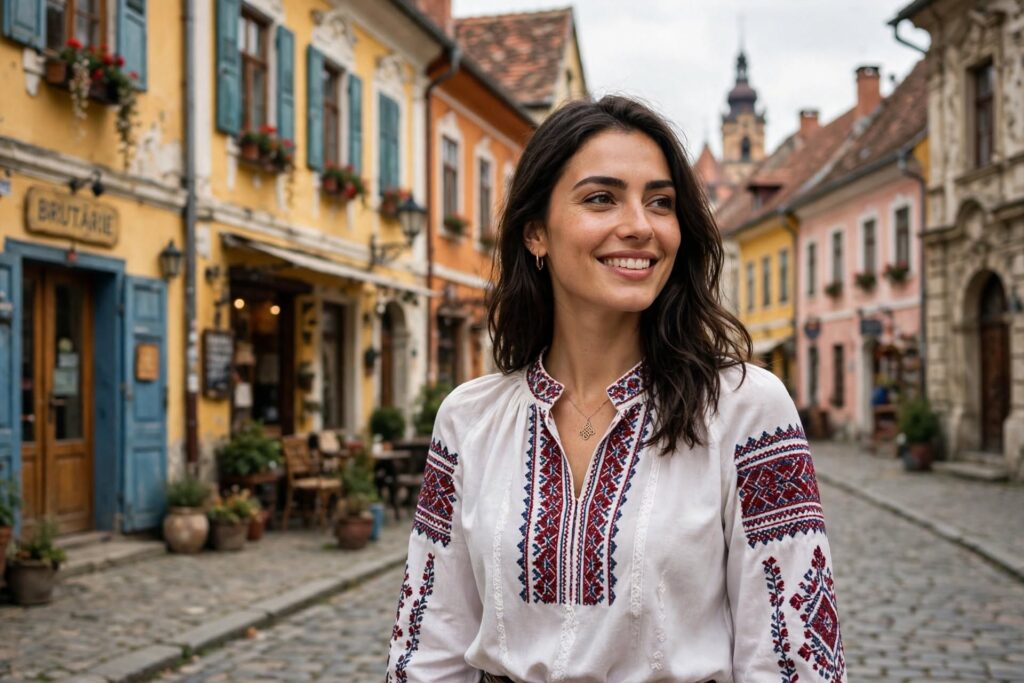
Romania does not fit neatly into any of the standard categories that Western men use when thinking about Eastern European women. It is not Slavic — Romanian is a Romance language, descended from Latin, and the culture carries that Latin influence in real and visible ways. It is not Western European either — the country’s history under communism, its Orthodox Christian heritage, and its specific relationship with family and community set it apart from France or Italy despite the linguistic kinship. Romanian women sit at this intersection, and they tend to surprise Western men who arrive with pre-formed expectations about what an Eastern European woman is like.
The Latin-Slavic mix and what it actually produces
Romanian women tend to be warmer and more socially expressive in initial contact than women from further east — from Ukraine or Russia, where reserve in early acquaintance is more pronounced. That Latin warmth is real. But it sits alongside a directness and a seriousness about relationships that is distinctly Eastern European. The combination can be disorienting if you are not expecting it: a Romanian woman can be immediately warm, engaged, and genuinely friendly — and also completely clear about what she is looking for and whether you fit the picture.
This is not a contradiction. It is just a different social register than what many Western men are used to. Warmth is not the same as casualness, and in Romanian culture it almost never is.
Family, tradition, and what that means in practice
Orthodox Christianity and strong family values shape Romanian culture in ways that run considerably deeper than active religious practice. Romanian women are generally family-oriented in the specific sense that family is genuinely central to how they organize their lives — not as a stated value but as a practical reality. Her parents’ opinions matter. Extended family gatherings are regular and important. Meeting her family, when the relationship becomes serious, tends to happen earlier than Western men expect and carries more weight than a meet-the-parents occasion would in most Western contexts.
Romanian women also tend to take hosting seriously. Food, home, warmth — these are expressions of care rather than domestic performance, and they reflect a cultural inheritance that equates taking care of the people you love with taking the relationship seriously. Western men who have been in relationships with Romanian women consistently describe the domestic warmth as one of the qualities that makes the relationship feel genuinely different from previous experience.
What Romanian women look for
Stability and reliability rank very highly — not in the sense of financial wealth, but in the sense of someone whose behavior is predictable in the good way: who does what he says, shows up consistently, and is the same person in month six that he was in month one. Romanian women have a well-developed radar for men whose effort drops off once they feel the relationship is secured, and a well-developed patience for men who demonstrate the opposite.
Genuine interest in Romania itself — its history, its culture, its specific character — also matters more than most Western men account for. Romania has an extraordinary literary tradition, a fascinating and complicated history, and a cultural depth that is largely invisible to Westerners who know the country primarily through Dracula and EU migration statistics. A man who arrives with genuine curiosity about where she comes from, rather than generic appreciation for Eastern European women, makes a specific impression that most men in her international dating experience do not.
Dating culture: what to do and what not to do
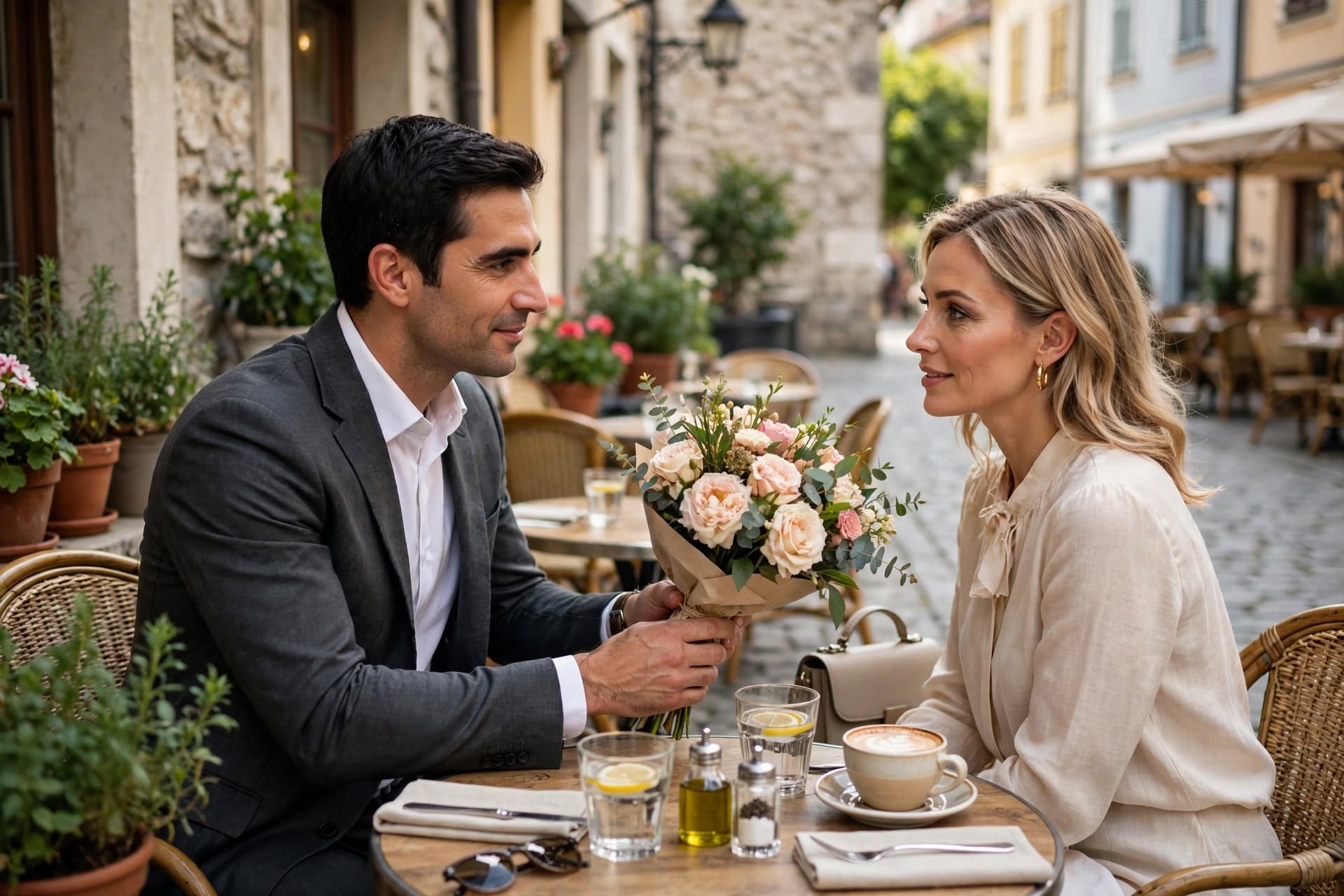
Flowers on first dates. Paying for the date. Dressing well. These are the same baseline expectations as elsewhere in Eastern Europe, and Romania is no exception. Romanian women put real effort into their personal presentation and notice when their partner does not.
Chivalry more broadly — opening doors, helping with a coat, small gestures of genuine attentiveness — reads as genuine care in Romanian culture rather than as performative gender politics. This does not mean Romanian women are passive or traditional in all respects: many are highly educated and professionally ambitious. It means that the specific domain of romantic courtship still operates with certain expectations that Western men ignore at their peril.
Do not discuss Romanian politics or recent history as if you know more about it than she does. Romania’s communist period, the Revolution of 1989, the post-communist transition — these are parts of her family’s living memory, not historical curiosities. Ask genuine questions if you are curious. Do not offer opinions before you have any basis for them.
Long distance and practical considerations
Romania is an EU member state, which simplifies travel and, for European citizens, the logistics of relocation. For American men, the K-1 fiancée visa process applies and is considerably less complicated than for women from Russia or Ukraine. Romanian passport holders travel visa-free to the United States for up to 90 days, and the immigration pathway to permanent residency, while still bureaucratic, does not carry current-events complications.
Romanian women who are seriously pursuing international relationships are generally open to the possibility of relocation, but they are leaving a real life behind — family, friends, professional networks, language. Acknowledging that reality, and showing genuine understanding of what she is giving up rather than focusing exclusively on what she is gaining, tends to matter considerably to women who are seriously weighing that decision.