Ask most people and they’ll tell you Europeans are reserved, analytical, and a little cold — while Latin Americans are all fire, rhythm, and passion. It’s one of the oldest stereotypes in international dating culture. It also doesn’t hold up particularly well once you look at the data.
This article takes an honest look at European women vs Latin women when it comes to passion, sexuality, and relationship culture — what the surveys actually found, where the myths came from, and why individual variation will always matter more than national averages.
What the Research Actually Shows About European Passion
A widely cited global survey on sexual behavior produced at least one genuinely surprising result: Greeks average around 138 sexual encounters per year — the highest of any nationality measured. That’s not a footnote. That’s the top of the global chart, and Greece is very much in Europe.
Italians, meanwhile, have a reputation for passion that long predates any survey — and that reputation isn’t built on nothing. Southern European culture in general runs warmer, more tactile, and more openly expressive than its Northern counterpart. The idea that Europeans are cold lovers is a generalization borrowed from one part of one continent and applied to all of it.
For comparison, the same research found Japanese respondents averaged around 45 sexual encounters annually, with Singapore closer to 73. The Asia-Europe contrast is real in the data — but it reflects cultural norms and social infrastructure around intimacy more than any inherent difference in passion.
Worth noting
Survey data on sexual frequency captures behavior, not passion. A couple having sex less often isn’t necessarily less passionate — cultural attitudes toward privacy, survey participation, and relationship structure all shape these numbers.
The “Latin Lover” Myth: Where It Comes From and What It Gets Wrong
The Latin lover stereotype has a specific origin: early Hollywood. Rudolph Valentino in the 1920s effectively created the template — dark, smoldering, irresistibly romantic. The archetype got recycled endlessly afterward, and somewhere along the way it stopped being about a film character and started being treated as a fact about an entire continent’s population.
The honest assessment of Latin dating culture myths is that they contain a grain of truth stretched into a caricature. Latin American cultures — particularly in countries like Brazil, Colombia, Argentina, and Mexico — do tend to be more physically expressive, more openly romantic in public, and more comfortable with direct displays of attraction than, say, German or Swedish culture. That’s a real cultural difference.
But “more expressive” is not the same as “better in bed,” “more passionate as a partner,” or “guaranteed to be a good match.” The stereotype collapses the moment you actually meet people from these countries, because the variation within any single Latin American nation is enormous. Someone from rural Mexico and someone from Buenos Aires have about as much in common culturally as someone from rural Alabama and someone from Manhattan.
The same solo European traveler who swears every trip to Latin America ends in romantic adventure is probably telling a story shaped by confirmation bias. Memorable experiences get remembered. Unremarkable ones don’t.
Why People from Latin Backgrounds Often Play Into the Stereotype
Here’s something that doesn’t get said often enough: a lot of people from Latin American backgrounds actively use the “Latin lover” label to their advantage — and it works. If being associated with Valentino, Carlos Gardel, Penélope Cruz, Sofia Vergara, or Salma Hayek gives you a social edge in a room, why argue against it?
That’s not dishonest. It’s just pragmatic social navigation. The label carries positive connotations — warmth, sensuality, romantic confidence — and those aren’t bad things to be associated with. The problem isn’t people leaning into the positive version of the stereotype. The problem is when the stereotype hardens into an expectation that individual people are required to live up to or be measured against.
A Latin man who doesn’t fit the “macho passionate lover” mold isn’t defective. A European woman who is openly warm and expressive isn’t an anomaly. These are just people.
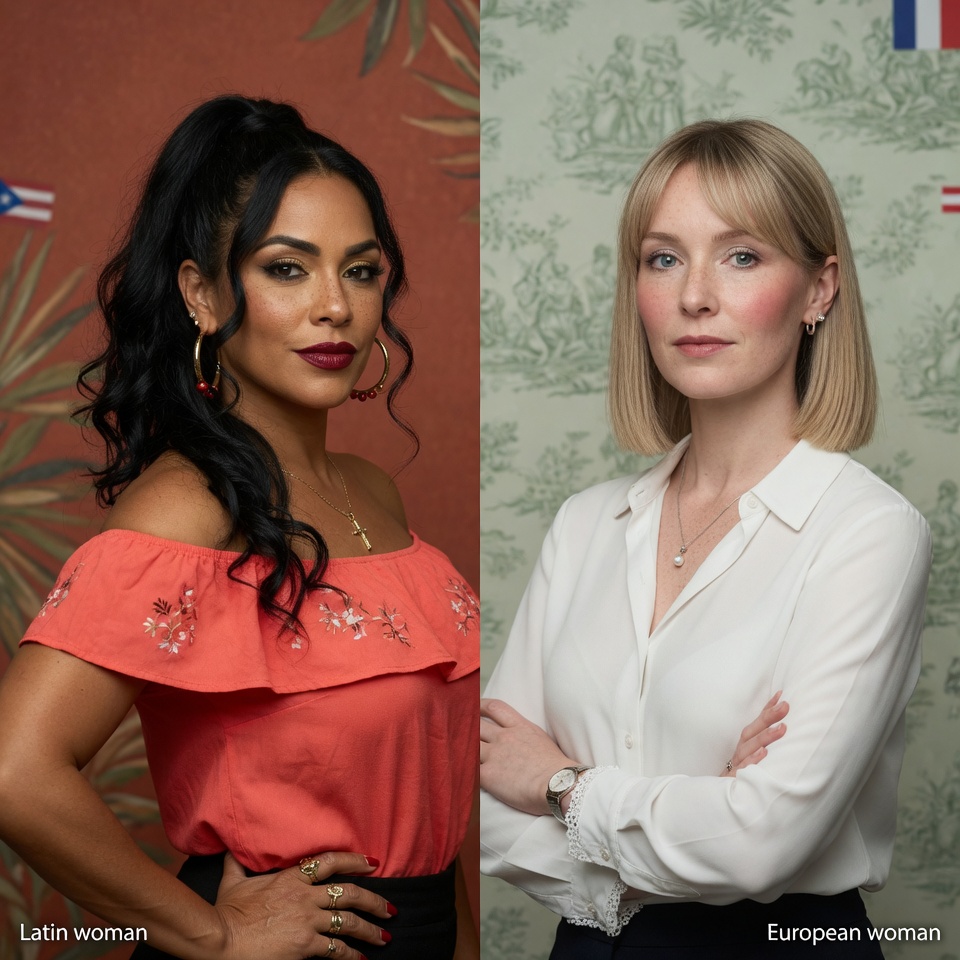
European Women vs Latin Women: What the Comparison Actually Looks Like
When people search for comparisons between European women and Latin women in relationships, they’re usually asking something more specific: who makes a better partner, or who is more passionate, or whose dating culture is more appealing to navigate.
The honest answer is that the comparison doesn’t really work at that level. Here’s why:
- Regional variation within Europe is massive. A Spanish woman and a Finnish woman have almost nothing in common culturally when it comes to romance and expression. Grouping them as “European” is like grouping Brazilian and Canadian women as “American.”
- Latin America is not a monolith either. Argentine dating culture differs significantly from Mexican, Colombian, or Venezuelan. The “passionate Latin” template fits some contexts and misses others entirely.
- Individual personality outweighs national origin. Every relationship study that has looked at long-term compatibility finds that shared values, communication style, and temperament matter far more than cultural background.
The Stereotypes That Are Worth Keeping (and the Ones That Aren’t)
Not all cultural generalizations are equally useless. Some reflect real differences in social norms that are worth knowing if you’re dating internationally.
It’s fair to say that Southern European and Latin American dating cultures tend to be more physically expressive and less emotionally guarded in early interactions than Northern European ones. That’s a genuine cultural pattern, not a myth. Walking into a first date in Medellín with the same emotional reserve you’d bring to one in Stockholm will read differently in each city.
What’s not worth keeping is the idea that passion is a fixed racial or national trait — that some groups of people are simply hotter, more sexual, or better lovers by virtue of where they were born. That version of the stereotype isn’t just imprecise. It reduces real people to a cartoon, and it sets up expectations that actual individuals can’t and shouldn’t have to meet.
The Bottom Line
Europeans are not uniformly cold. Greeks have some of the highest recorded sexual activity in the world. Italians have built an entire cultural identity around warmth and romantic expressiveness. Southern Europe in general runs much warmer than the Northern European stereotype suggests.
Latin lovers are not uniformly hot. The archetype is a Hollywood invention that got taken too seriously. Latin American dating culture does tend to be more openly expressive — but that’s a starting point for understanding, not a guarantee of anything.
The most useful frame for international dating culture differences isn’t “who is more passionate.” It’s understanding that different cultures have different defaults around expression, pace, and directness — and that knowing those defaults helps you navigate unfamiliar social situations without misreading people. After that, you’re just dealing with individuals.Comparison of passion, dating style and cultural differences between European and Latin girls.