Online dating platforms connecting Western men with Eastern European women are a legitimate and well-established industry. They’re also a space with a long, well-documented history of fraud. The two things coexist, which means the challenge isn’t avoiding the category entirely — it’s knowing how to navigate it without getting burned.
This guide covers every major Eastern European dating scam pattern currently operating, how to identify them before they cost you money or time, and what genuine platforms actually look like in practice.
Why Eastern European Dating Sites Attract Scammers
The economics are straightforward. Western men on these platforms are often emotionally invested, willing to spend money, and operating at an information disadvantage — they don’t speak the local language, can’t verify local addresses, and are relying on the platform to be honest with them. That combination makes them attractive targets.
Add in the fact that some platforms are structured to profit from long correspondence rather than actual meetings, and you have an environment where fraud isn’t just possible — in some cases, it’s baked into the business model.
Understanding that distinction is the foundation of everything else in this guide.
The Most Common Scam Types to Know
1. The Pay-Per-Letter Trap
This is the most widespread and costly scam in the Eastern European dating space. It works like this: you pay for credits or tokens to send and receive messages on a platform. The woman you’re talking to seems genuinely interested — responsive, warm, personal. What you don’t know is that her profile may be managed by an agency employee whose job is to keep you writing. Every message you send costs money. Every reply costs money. There is no upper limit.
Men have spent thousands of dollars in extended “relationships” with profiles that were never connected to a real person on the other end. The tell is usually that the conversation never progresses toward a real meeting, video call, or any form of verifiable contact outside the platform.
Red flag
Any platform that charges per message sent or received has a financial incentive to keep you messaging indefinitely. This model is incompatible with a service that genuinely wants to help you find a partner.
2. Fake Profiles and Stolen Photos
Some profiles on lower-quality platforms are entirely fabricated — photos taken from social media, modelling sites, or other dating platforms, attached to a fictional identity. The person you’re talking to may not exist at all, or may look nothing like their photos.
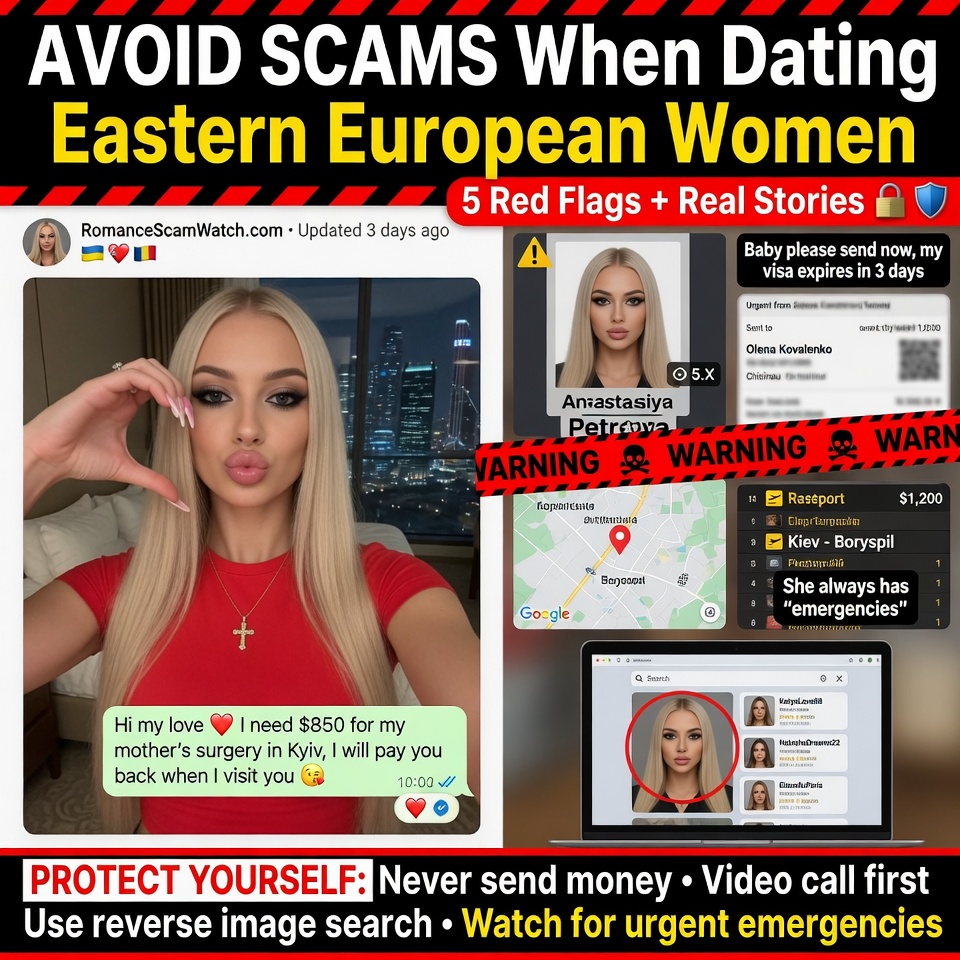
Reverse image search is your first line of defense here. Right-click any profile photo and run it through Google Images or TinEye. If the same photo appears under a different name on another platform, or as a stock photo, or on a model’s Instagram account, you have your answer.
3. The Emergency Money Request
This one follows a predictable script. You’ve been talking for weeks or months, things feel genuine, and then a crisis appears: a sick relative, a lost wallet, a missed rent payment, a medical bill. The request for help is framed as temporary and embarrassed — she hates asking, she’ll pay you back, she just doesn’t know who else to turn to.
The amounts start small and escalate. Sometimes the “emergency” repeats with variations. This scam works because by the time the request arrives, the emotional investment is real — even if the relationship isn’t. The rule here is simple and absolute: never send money to someone you haven’t met in person, regardless of how long you’ve been talking or how convincing the situation seems.
4. The Visa and Travel Scam
A variation on the emergency request, specifically targeted at men who are planning to meet the woman in person. She wants to visit you, or you’ve agreed to meet — but she needs help covering her visa application fee, her travel insurance, her flight deposit. The money is sent. The visit never happens. Contact fades or another emergency appears.
Legitimate travel costs are handled directly and verifiably. If someone is asking you to send cash or a wire transfer for travel documents, that’s not how legitimate travel works and it’s not a request you should fulfill.
5. The Translator Scam
Some agencies provide “translation services” as part of their platform — and charge for every translated message. In some cases, the translation is real but inflated in cost. In others, the translator is writing the messages themselves, with no meaningful input from the woman whose profile you’re contacting. You’re essentially paying to correspond with a professional message-writer.
If a platform makes direct communication — video calls, exchanging personal contact details — difficult or expensive, ask why. The answer usually reveals something about how the business makes its money.
6. The Dating Tour Setup Fee Scam
Dating tours to Ukraine, Russia, or other Eastern European countries are a real and legitimate service when run honestly. They’re also a format that gets exploited. The scam version involves paying a significant upfront fee for a tour that promises pre-arranged dates — and then delivering poorly matched introductions, cancelled meetings, or women who are clearly there professionally rather than genuinely.
Research any dating tour operator thoroughly before paying. Look for independently written reviews outside their own website, check how long they’ve been operating, and ask specific questions about how women are recruited and verified for their events.
How to Verify Whether a Profile Is Real
Beyond reverse image search, several practical steps help separate genuine profiles from fabricated ones when verifying Eastern European dating profiles:
- Request a video call early. A real person will agree to a video call without difficulty. Excuses — bad internet, broken camera, uncomfortable with video — are worth taking seriously as warning signs, especially if they persist across multiple requests.
- Ask specific, personal questions. Generic responses that could apply to anyone (“I love walks, music, and good food”) are easier to fabricate than specific ones. Ask about her neighborhood, her job, something she mentioned previously. Genuine people remember their own stories.
- Look for consistency across time. Real people have consistent details across multiple conversations. Profile-managed accounts sometimes slip — different ages, different job descriptions, contradictory information about family or location.
- Ask to move to a neutral platform. Suggest continuing the conversation on WhatsApp, Telegram, or email. A real woman will have no objection. An agency managing her profile on a pay-per-message platform has every reason to keep communication locked inside the paid system.
What Legitimate Eastern European Dating Agencies Actually Look Like
The scam-heavy end of this industry has a mirror image: genuinely useful services that have helped thousands of people find real relationships. Knowing what legitimate Eastern European dating agencies look like makes the fraudulent ones easier to spot by contrast.
- Flat subscription pricing, not per-message credits. You pay for access, not for each interaction.
- Verified profiles with documented identity checks — ideally including in-person interviews conducted by local staff.
- Easy video calling built into the platform at no extra charge.
- Encouragement of real meetings. A legitimate agency actively helps you plan a visit and meet the women you’ve been talking to. Their reputation depends on successful matches, not prolonged correspondence.
- Transparent terms and refund policies. Read these before paying anything. Platforms that bury their terms or make cancellation difficult are telling you something.
- Real reviews on independent platforms — Trustpilot, Reddit, or niche dating review sites. Every platform looks good on its own testimonials page.
Protecting Yourself Emotionally, Not Just Financially
The financial cost of dating scams is real and sometimes significant. The emotional cost is harder to measure and often worse. Men who’ve been through extended fake relationships — sometimes lasting months — describe the discovery as genuinely painful, not just embarrassing. The connection felt real. The loss of it is real, even when the other person wasn’t.
The best protection is early verification. The longer you invest emotionally before confirming you’re talking to a real person who is genuinely interested, the harder the eventual discovery becomes. This isn’t cynicism — it’s just the practical reality of a space where fraud exists alongside genuine opportunity.
Move toward video calls within the first few exchanges. Suggest meeting in person within the first month of real conversation. A woman who is genuinely interested in a relationship will want the same things you do — real contact, real verification, real progress. Resistance to those things, sustained over time, is information worth taking seriously.
The Bottom Line
Dating Eastern European women online is not inherently risky — but it requires more active skepticism than domestic dating, simply because the information gap between you and the other person is larger and easier to exploit.
The rules are straightforward: use platforms with flat pricing and verified profiles, request video calls early, never send money regardless of the story, and treat any resistance to real-world contact as a meaningful warning sign. Apply those consistently and the legitimate part of this market — which is real and large — becomes much easier to find.